
















































































































Text NAVYBONUS to 764764 for information.
Text HELP for help. Msg & data rates may apply.
Call

Talk to a Navy recruiter. From STEM careers to Navy life, get the answers to your burning questions.

1-800-USA-NAVY

CHAT
Chat Now

Chat with a Navy expert about top STEM careers, unique scholarship opportunities, our culture of excellence, or any other burning questions you might have.

Start Chat

Hours

MON–FRI
8:00am - 10:00pm CST
SAT–SUN
10:00am - 10:00pm CST

Closed on federal holidays.

Rules

Before you start a chat, please read our chatroom rules:

  • You must be at least 17 years of age to enter the chat.
  • To use Navy live chat, you must enter a username.
  • Chats will only be conducted during specified hours of operation.
  • Profanity, abusive language and any material deemed unacceptable will not be permitted.
  • If you attempt to use profanity or abusive language, or provide material deemed unacceptable, the chat will be terminated, and you may be barred from future sessions.

Privacy Notice

This chat system is intended for general Navy recruiting inquiries only. To protect your privacy, please do not submit sensitive personal information through the chat platform, including Social Security numbers, medical information, medical records, medical documentation, financial information, or other protected/sensitive data.

If your question or situation requires discussion of sensitive personal information, a recruiter can contact you by phone.

Troubleshooting

Don't see a chat button on this page? Try using a different internet browser. There is a known issue affecting some users from accessing the chat button. We are actively working to fix this issue.

SUBSCRIBE

Make sure you’re getting the latest updates and information about top STEM career opportunities, benefits, day-to-day life in the Navy and more. We will only use your information for our communications. You can also talk to a Navy recruiter.

* Required Field

You must be 13 years old or older to subscribe to Navy emails.

Phone w 0 Fill 1 Created with Sketch.

Call

Chat w 0 Group 2 Created with Sketch.

CHAT

Mail w 0 Group 3 Created with Sketch.

SUBSCRIBE

Navy Ranks

A Navy officer is recognized for his shore command with a pin from his wife

Navy Ranks - Structure Accordions

Navy Rank Structure

Understanding the difference between Enlisted Sailors, Warrant Officers and Commissioned Officers is one of the most common questions prospective Sailors have. While every path supports the Navy's mission, each follows a unique career progression with differing responsibilities.

Enlisted Personnel

Enlisted Sailors form the operational backbone of the U.S. Navy. They are highly trained professionals responsible for operating advanced equipment, maintaining mission readiness and carrying out the day-to-day work that keeps the fleet moving. 

Most Enlisted careers begin after Boot Camp and specialized job training, where Sailors develop technical expertise in a specific career field, known as a rating. As they gain experience and demonstrate leadership, they advance from technical contributors to supervisors, mentors and Enlisted leaders. 

As Petty Officers (E-4 through E-6) and Chief Petty Officers (E-7 through E-9), Enlisted Sailors take on greater leadership responsibilities beyond technical excellence. These Non-Commissioned Officers (NCOs) lead teams, train Junior Sailors, advise Officers and help ensure their commands remain mission ready. 

Learn more about Enlisted Personnel 

Warrant Officers

Warrant Officers are technical experts who have earned recognition through years of Enlisted experience and exceptional performance. Rather than leading broad organizations like Commissioned Officers, Warrant Officers specialize in highly technical fields where deep operational knowledge is critical to mission success. 

They serve as trusted advisors to Commanders, mentor Sailors within their specialty and help solve complex operational challenges across the fleet. Their combination of leadership and technical mastery makes them an essential link between Enlisted expertise and Commissioned leadership. 

Commissioned Officers

Commissioned Officers lead Sailors, direct missions and make decisions that shape operations across the Navy. Most Officers begin their careers after earning a bachelor's degree through programs such as Officer Candidate School (OCS), the U.S. Naval Academy or Naval ROTC. 

While Enlisted Sailors focus on developing technical expertise within a specific rating, Officers are responsible for leading people, managing resources, planning operations and accomplishing mission objectives. As they advance, they oversee larger organizations and take on greater strategic leadership responsibilities across the fleet. 

Learn more about Officers 

Navy Ranks & Insignias

Every Navy career includes opportunities to progress through the ranks. Advancement is earned through performance, leadership, professional development and demonstrated expertise. 

Explore each rank below to learn how responsibilities evolve throughout a Navy career. 

Enlisted Ranks

Junior Enlisted: E-1 to E-3

Every Navy career begins with building a strong foundation. Junior Enlisted Sailors complete training, develop technical skills and gain hands-on experience while learning the standards, discipline and teamwork that define Navy service. As they grow, they prepare for increased responsibility and future leadership opportunities.

Navy Seaman Recruit insignia
E-1

Seaman Recruit (SR)

Seaman Recruits begin their Navy careers by completing foundational training and learning the core values, skills and responsibilities required to serve. They develop the discipline, teamwork and operational knowledge needed for success throughout their careers.

Navy Seaman Apprentice insignia
E-2

Seaman Apprentice (SA)

Seaman Apprentices continue developing technical skills while supporting daily operations within their assigned command. Through hands-on experience and continued training they build confidence and prepare for increased responsibility.

Navy Seaman insignia
E-3

Seaman (SN)

Seamen contribute directly to mission success by applying their technical training in operational environments. At this stage, Sailors are expected to demonstrate greater independence, accountability and proficiency while preparing for advancement into leadership roles.

Petty Officers: E-4 to E-6

Petty Officers are the Navy's first level of Enlisted leadership. They combine technical expertise with responsibility for mentoring Junior Sailors, supervising daily operations and ensuring work is completed safely, efficiently and to the Navy's standards.

Navy Petty Officer Third Class insignia
E-4

Petty Officer Third Class (PO3)

Petty Officer Third Class marks the transition from individual contributor to leader. These Sailors supervise junior personnel, apply advanced technical knowledge and begin developing the leadership skills needed to guide teams and accomplish mission objectives.

Navy Petty Officer Second Class insignia
E-5

Petty Officer Second Class (PO2)

Petty Officer Second Class oversees work centers, mentors Junior Sailors and serves as a trusted technical expert. They help maintain readiness by ensuring personnel, equipment and daily operations meet mission requirements.

Navy Petty Officer First Class insignia
E-6

Petty Officer First Class (PO1)

Petty Officer First Class leads larger teams while coordinating operations, managing resources and developing future leaders. Their experience and leadership prepare them for advancement into the Navy's Senior Enlisted ranks.

Senior Enlisted Leaders: E-7 to E-9

Senior Enlisted leaders are the Navy's most experienced technical experts and mentors. They advise Officers, develop future leaders, uphold Navy standards and help ensure their commands remain ready to accomplish the mission. Their experience, judgment and leadership influence every level of the organization.

Navy Chief Petty Officer insignia
E-7

Chief Petty Officer (CPO)

Chief Petty Officers are recognized experts in their rating and respected leaders across the fleet. They supervise Sailors, mentor junior leaders and provide Commanders with trusted technical advice. Becoming a Chief marks a significant milestone in an Enlisted Navy career and reflects proven leadership, professionalism and operational expertise.

Navy Senior Chief Petty Officer insignia
E-8

Senior Chief Petty Officer (SCPO)

Senior Chief Petty Officers lead larger teams, departments and programs while advising command leadership on personnel, training and mission readiness. Their experience helps shape command culture, develop future Chiefs and ensure Sailors have the support they need to succeed.

Navy Master Chief Petty Officer insignia
E-9

Master Chief Petty Officer (MCPO)

Master Chief Petty Officers represent the highest level of Enlisted leadership. They serve as senior advisors to commanding Officers, mentor Sailors across the command and help guide decisions that affect mission readiness, professional development and the overall success of the Navy's Enlisted force.

Warrant Officer Ranks

Warrant Officers: W-1 to W-5

Warrant Officers are highly experienced technical specialists who have advanced from Enlisted ranks. Their deep expertise allows them to solve complex challenges, advise Commanders and strengthen the Navy's operational capability across specialized fields.

Navy Warrant Officer 1 insignia
W-1

Warrant Officer 1 (WO1)

Warrant Officer 1 marks the beginning of the Warrant Officer career path. These technical specialists apply years of Enlisted experience to support operations, provide expert guidance and strengthen mission readiness within their specialty.

Navy Chief Warrant Officer 2 insignia
W-2

Chief Warrant Officer 2 (CWO2)

Chief Warrant Officer 2 serves as a trusted technical leader, applying extensive operational expertise to oversee programs, mentor Sailors, and advise command leadership on specialized systems and mission requirements.

Navy Chief Warrant Officer 3 insignia
W-3

Chief Warrant Officer 3 (CWO3)

Chief Warrant Officer 3 assumes broader technical leadership responsibilities, managing larger programs while providing expert guidance on complex operational challenges. Their experience helps develop personnel and sustain the Navy's technical excellence.

Navy Chief Warrant Officer 4 insignia
W-4

Chief Warrant Officer 4 (CWO4)

Chief Warrant Officer 4 is recognized as an authority within their specialty. They advise senior leaders, influence technical standards and help shape policies and procedures that improve readiness across the fleet.

Navy Chief Warrant Officer 5 insignia
W-5

Chief Warrant Officer 5 (CWO5)

Chief Warrant Officer 5 represents the highest level of technical leadership within the Warrant Officer community. They serve as senior advisors on critical capabilities, guide long-term initiatives and help ensure the Navy remains ready to meet future operational challenges.

Commissioned Officer Ranks

Junior Officers: O-1 to O-3

Junior Officers build the leadership foundation that will guide their careers. They gain operational experience, lead divisions of Sailors, manage resources and develop the technical and decision-making skills needed to take on increasingly complex assignments.

Navy Ensign insignia
O-1

Ensign (ENS)

Ensign is the first Commissioned Officer rank in the Navy. Newly Commissioned Officers begin applying their education and training by leading Sailors, managing daily operations and developing the judgment and experience needed to succeed throughout their careers.

Navy Lieutenant Junior Grade insignia
O-2

Lieutenant Junior Grade (LTJG)

Lieutenant Junior Grades continue expanding their leadership skills while taking on greater operational responsibility. They lead teams, oversee mission execution and strengthen the technical and management skills that prepare them for future command opportunities.

Navy Lieutenant insignia
O-3

Lieutenant (LT)

Lieutenants serve in key leadership positions across the fleet, often leading divisions, managing critical operations and mentoring Junior Officers. Their growing experience allows them to balance technical expertise with leadership while supporting complex missions in operational environments.

Senior Officers: O-4 to O-6

Senior Officers oversee larger organizations, lead departments and direct operations that affect hundreds of Sailors. They manage resources, develop future leaders and ensure their commands remain prepared to accomplish the Navy's mission.

Navy Lieutenant Commander insignia
O-4

Lieutenant Commander (LCDR)

Lieutenant Commanders serve in senior leadership roles aboard ships, submarines, aviation squadrons, shore commands and special operations units. They supervise departments, coordinate operations and help translate strategic priorities into mission success.

Navy Commander insignia
O-5

Commander (CDR)

Commanders lead major departments, aviation squadrons, submarines, destroyers and shore activities, depending on their community and assignment. They are responsible for mission readiness, operational performance and the professional development of the Sailors and Officers they lead.

Navy Captain insignia
O-6

Captain (CAPT)

Captains hold some of the Navy's most significant command positions. Depending on their assignment, they may command major warships, aviation wings, submarines, shore installations or other large organizations. Their decisions influence operational readiness, long-term planning and mission success across the fleet.

Flag Officers: O-7 to O-10

Flag Officers provide executive leadership for the Navy at the highest levels. They oversee major commands, guide operational strategy, allocate resources and shape policies that strengthen the Navy's ability to protect national security around the world.

Navy Rear Admiral Lower Half insignia
O-7

Rear Admiral (Lower Half) (RDML)

Rear Admirals (Lower Half) oversee large organizations and operational commands while coordinating efforts across multiple units. Their leadership helps ensure personnel, resources and capabilities remain aligned with mission objectives.

Navy Rear Admiral insignia
O-8

Rear Admiral (Upper Half) (RADM)

Rear Admirals (Upper Half) direct major operational organizations and provide strategic leadership across the fleet. They oversee complex missions, guide senior leaders and help ensure the Navy remains prepared to meet evolving global challenges.

Navy Vice Admiral insignia
O-9

Vice Admiral (VADM)

Vice Admirals serve in some of the Navy's most senior leadership positions, overseeing major commands and shaping policies that influence operations across the fleet. Their decisions support national defense priorities and strengthen the Navy's global readiness.

Navy Admiral insignia
O-10

Admiral (ADM)

Admiral is the highest Active Duty rank in the U.S. Navy. Admirals provide strategic leadership for major fleets, combatant commands and Navy organizations, helping guide global operations, national defense strategy and the future direction of the service. 

Curious About a Career in the Navy?

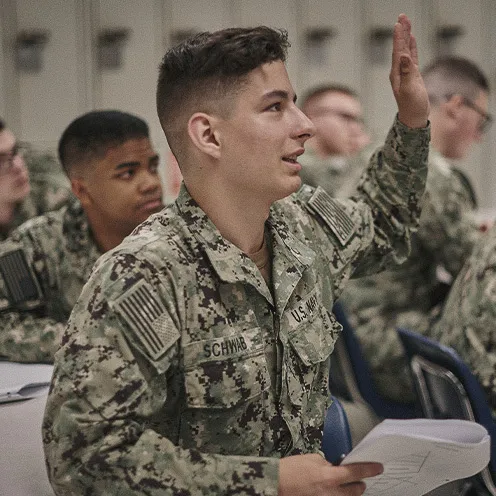
A student at Naval Nuclear Power School wearing his camouflage uniform raises a hand to answer a question while seated in a classroom with other Sailors.

Curious About a Career in the Navy?

Whether you're interested in hands-on technical work, leading teams, flying aircraft, practicing medicine, engineering advanced technology or serving aboard ships and submarines, the Navy offers more than 150 careers that support missions around the world.

Frequently Asked Questions

What is the difference between rank and rate in the Navy?

A rank identifies a Sailor's level of authority and leadership within the Navy, while a rate identifies an Enlisted Sailor's job specialty. 

For example, someone may hold the rank of Petty Officer Second Class (E-5) while serving in the rate of Hospital Corpsman, Machinist's Mate or another Enlisted career field. Officers have ranks but do not have rates. Instead, they belong to officer communities such as aviation, surface warfare, submarines or medical service. 

What is a Petty Officer?

A Petty Officer is an Enlisted leader in the U.S. Navy serving in paygrades E-4 through E-6. 

Petty Officers supervise Junior Sailors, provide technical expertise and help ensure daily operations are completed safely and effectively. They also mentor junior personnel while preparing for increased leadership responsibilities within their commands. 

What is the highest rank in the Navy?

The highest Active Duty rank in the U.S. Navy is Admiral (O-10). 

Admirals serve in the Navy's most senior leadership positions, overseeing major fleets, commands and strategic operations that support national defense and global security. 

What is a Commissioned Officer in the Navy?

A Commissioned Officer is a military leader appointed by the President of the United States to lead Sailors, direct operations and manage missions. 

Most Officers earn a bachelor's degree before commissioning through programs such as Officer Candidate School (OCS), the U.S. Naval Academy or Naval ROTC. Throughout their careers, Officers take on increasing leadership responsibilities as they advance through the Navy Officer ranks. 

What is a Non-Commissioned Officer (NCO) in the Navy?

In the Navy, Petty Officers (E-4 through E-6) are commonly considered the Navy's Non-Commissioned Officers because they supervise Sailors and lead work centers. 

Chief Petty Officers (E-7 through E-9) further develop that leadership by serving as Senior Enlisted advisors, mentors and technical experts who help guide both Sailors and Officers. 

What is a Warrant Officer?

A Warrant Officer is a highly experienced technical specialist who has advanced from the Enlisted ranks after demonstrating exceptional expertise and leadership. 

Rather than focusing on broad organizational leadership like Commissioned Officers, Warrant Officers provide advanced technical knowledge, advise commanders and help solve complex operational challenges across specialized fields. 

What rank is Chief in the Navy?

The title Chief refers to a Chief Petty Officer (CPO), which is the Enlisted paygrade of E-7. 

Becoming a Chief is one of the most respected milestones in an Enlisted Navy career. Chiefs serve as Senior Enlisted leaders responsible for mentoring Sailors, advising Officers and maintaining mission readiness throughout their commands. 

How fast can you move up through the Navy ranks?

Advancement in the Navy depends on several factors, including performance, time in service, leadership ability, available opportunities and career field requirements. 

Advancement through the Junior Enlisted ranks may occur relatively quickly, while promotion to Senior Enlisted and Officer leadership positions requires increased experience, demonstrated performance and continued professional development. 

Do college credits increase rank when enlisting in the Navy?

In some cases, yes. 

Applicants who have earned qualifying college credits or completed certain programs before enlisting may be eligible to begin their Navy careers at an advanced Enlisted paygrade rather than E-1. Eligibility depends on current Navy policies and individual qualifications. 

Do prior Enlisted members lose rank when becoming Officers?

No. Prior Enlisted Sailors who become Commissioned Officers do not lose the experience they earned while serving Enlisted. 

Although they begin at the entry-level Officer rank of Ensign (O-1) in most cases, their previous military experience often provides valuable leadership knowledge and perspective throughout their Officer careers.